Calm Words, Clear Feelings: Mindful Communication Guide

Finding the right words can be difficult when you are disappointed, uncertain, or overwhelmed. Emotional clarity starts with a small pause: notice what you feel, consider what matters to you, and choose how you want to express it.
Our digital guide, Calm Words, Clear Feelings, is for readers interested in exploring calmer expression and more mindful communication. You do not need perfect words to begin a useful conversation. You can start by getting a little clearer about your own experience.
Why Emotional Clarity Matters
A feeling and the situation that prompted it are connected, but they are not the same thing. If a plan changes suddenly, for example, the change is what happened; disappointment or frustration may be what you feel about it. Naming that distinction can help you describe your experience without assuming you know why someone acted as they did.
Mindful communication makes space for both honesty and listening. You can say what matters to you while remaining curious about another person’s perspective. That does not mean avoiding difficult subjects or pretending everything is fine. It means approaching the conversation with care for your words and attention to what you hear.
A calmer approach may support a conversation, but it cannot guarantee a particular response. The other person may need time, disagree, or be unwilling to engage. You can choose how you communicate without taking responsibility for controlling their reaction.
For more on paying attention to the present moment, see the National Institutes of Health’s overview of mindfulness for your health.
Meet Calm Words, Clear Feelings
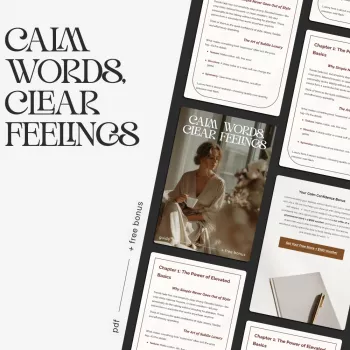
We offer Calm Words, Clear Feelings emotional clarity guide as a digital-download eBook for readers interested in emotional clarity and mindful communication. It is listed at $9.99 USD; visit the product page for purchase details.
A self-guided resource can be a convenient choice if you want to reflect at your own pace. Consider whether you are looking for ideas to support your communication goals or whether your situation calls for more individualized help.
From Feelings to Clearer Words
When you are ready to speak, try moving through four steps: pause, name the feeling, identify the concern, and make a clear request. The pause gives you a moment to decide what you want to communicate. Naming the feeling helps you focus on your experience, while identifying the concern connects it to what matters to you.
A request gives the other person something specific to consider. It might be a request for more notice, a break, or an explanation. You can ask without demanding an immediate answer, and you can also be clear about a boundary when you need one.
The examples below are starting points, not scripts you must follow. Adapt the wording to your situation, your relationship, and the boundaries that feel appropriate.
Ways to Express a Feeling More Clearly
| Situation | Feeling or concern | Possible words |
|---|---|---|
| A plan changes without notice | Disappointment and a need for notice | I felt disappointed when the plan changed. Could you let me know earlier next time? |
| A conversation becomes tense | Overwhelm and a need for a pause | I’m feeling overwhelmed. Can we take a break and come back to this? |
| A request feels unclear | Uncertainty and a need for clarity | I’m not sure what you need from me. Could you explain it a little more? |
If a request is not possible, you can discuss alternatives. For instance, someone may not always be able to give advance notice, but you might agree on a way to communicate changes as soon as possible. Clarity helps you discover what each person can reasonably offer.
Making Space for a Better Conversation
Whenever possible, choose a time when you can both give the topic some attention. Starting a sensitive discussion in the middle of a rush may leave little room to listen. If now is not a good time, you can ask when you might talk instead.
Speak from your own experience rather than making broad claims about the other person’s intentions. After you share, leave room for a response. Listening does not require you to agree, accept hurtful behavior, or give up your boundaries. It simply allows you to understand what the other person is saying before deciding what comes next.
Before a conversation, our team suggests a brief reflection: What do I feel, what matters to me, and what would I like to ask? You might jot down a few words or type a note to organize your thoughts. If typing is part of your routine, our Rapid Trigger Magnetic 65% Gaming Keyboard is another option in our store.
Choosing Support for Your Communication Goals
A digital guide may suit you if you enjoy independent reflection and want a resource you can return to as you consider your communication habits. Think about the kind of support you need now: a self-guided resource, a conversation with someone you trust, or professional care.
An eBook is not a substitute for mental health care or support in an unsafe relationship. If you are concerned about your mental health, the National Institute of Mental Health offers information on caring for your mental health and seeking help. If a relationship feels unsafe, consider reaching out to a trusted person or a local support service rather than relying on communication techniques alone.
If a self-guided resource fits your goals, we invite you to explore Calm Words, Clear Feelings on its product page.
FAQ
What is Calm Words, Clear Feelings?
Calm Words, Clear Feelings is an emotional clarity and mindful communication eBook offered as a digital download.
How can I practice expressing feelings calmly?
Pause, name what you feel, describe your concern, and make a clear request. Leave room to listen to the other person’s response.
Can a communication guide replace professional support?
No. A self-guided resource is not a substitute for mental health care or help with an unsafe situation.













Leave a comment